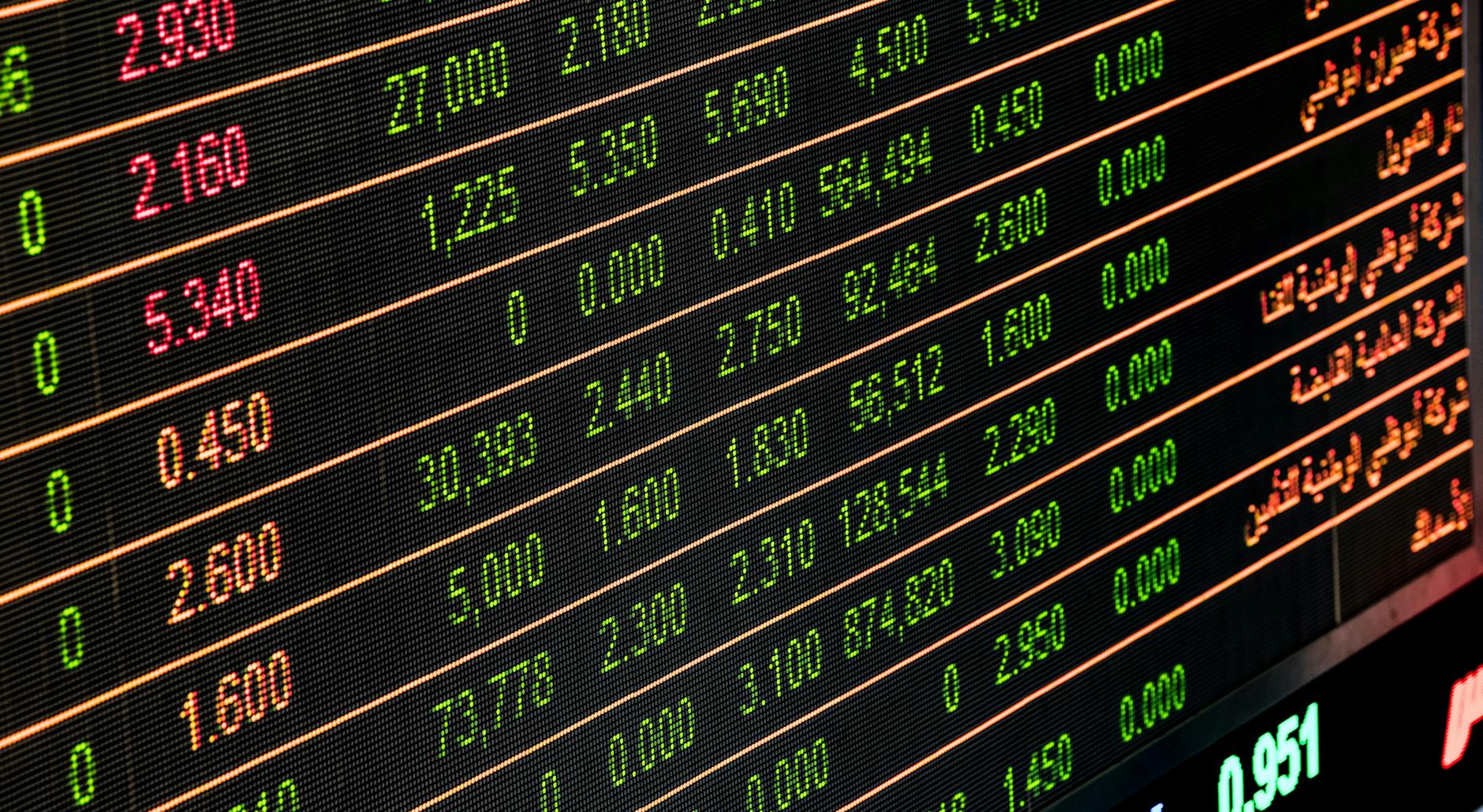
- Financial markets enable capital allocation, price discovery, and liquidity across equities, bonds, forex, and derivatives.
- Global forex trading averages $7.5 trillion daily (BIS 2025), making it the largest market by volume.
- Markets are not perfectly efficient, behavioral factors and liquidity gaps create both risks and opportunities.
- Useful for: long-term investors who diversify across asset classes and understand market structure.
- Less suitable for: short-term traders ignoring transaction costs, liquidity, and behavioral risks.
Financial markets are the infrastructure through which capital moves from those who have it to those who need it, investors to governments, corporations, and entrepreneurs. the global financial market ecosystem includes public exchanges, over-the-counter networks, and electronic trading platforms that together enable trillions of dollars in daily transactions. Understanding how these markets operate is essential for anyone managing a portfolio, raising capital, or analyzing the economy.
Markets serve two core functions: price discovery and capital allocation. Price discovery determines the market value of assets through supply and demand. Capital allocation directs savings toward productive investments. This article covers the main types of financial markets, equity, fixed income, forex, and derivatives, their participants, and how they interact.
1. What Are Financial Markets? Types and Core Functions
What Are Financial Markets?
Financial markets are venues, physical or electronic, where securities, commodities, currencies, and derivatives are traded. They connect buyers and sellers, enable price discovery, and facilitate capital formation. Without financial markets, savers would have limited ways to invest and borrowers would struggle to find capital.
Four broad categories dominate:
- Equity markets: Shares of publicly traded companies. Investors buy ownership stakes; companies raise equity capital.
- Fixed income markets: Government and corporate bonds. Issuers borrow funds; investors receive periodic interest plus principal at maturity.
- Foreign exchange markets: Currency trading. The largest market by volume, over $7.5 trillion daily in 2025 (BIS Triennial Survey).
- Derivatives markets: Futures, options, swaps. Contracts whose value derives from an underlying asset, index, or event. Used for hedging and speculation.
A key distinction exists between primary markets, where new securities are issued (e.g., an IPO or a Treasury auction), and secondary markets, where existing securities trade among investors. Secondary markets provide liquidity and price transparency.
| Market Type | Daily Volume (Approx.) | Primary Function | Example |
|---|---|---|---|
| Equity | $300–600 billion | Ownership & capital formation | NYSE, Nasdaq |
| Fixed Income | $800 billion–$1 trillion | Borrowing & lending | Treasury market, corporate bonds |
| Foreign Exchange | $7.5 trillion (BIS 2025) | Currency exchange & hedging | EBS, Reuters Dealing |
| Derivatives | $500 billion (exchange-traded) | Risk transfer & price discovery | CME, ICE, Eurex |
2. Primary vs. Secondary Markets: Where Securities Are Created and Traded
Primary markets are where issuers sell new securities directly to investors. When a corporation lists shares in an initial public offering (IPO), or a government auctions Treasury bonds, that transaction happens in the primary market. Proceeds go to the issuer, not a prior holder. Underwriters, typically investment banks, manage the process, set the initial price, and distribute securities.
Secondary markets are where investors trade existing securities among themselves. The issuing company receives no proceeds from secondary trades. But secondary markets provide liquidity, the ability to buy or sell quickly without a large price impact, which makes primary market investors willing to participate in the first place.
Most secondary trading happens on exchanges (centralized order books) or over-the-counter (OTC) via dealer networks. Exchanges like the NYSE and Nasdaq use electronic order matching with real-time price transparency. OTC markets, especially for bonds and swaps, rely on dealers who quote bid-ask spreads negotiated bilaterally.
The distinction matters for investors. A liquid secondary market means lower transaction costs and faster execution. Illiquid secondary markets can make it expensive to exit a position, a risk especially in corporate bond and small-cap equity markets.
A 2024 Federal Reserve study found that bid-ask spreads on the NYSE averaged about 0.03% for large-cap stocks but could exceed 0.8% for small-cap stocks with limited trading volume. Bond market spreads were wider: investment-grade corporate bonds averaged 0.08% (8 basis points), while high-yield bonds ranged from 0.25% to 0.75% depending on issuance size and credit quality.
Financial Markets: A Beginner's Guide
Key concepts, participants, and facts about how capital markets work.
Read Market Structure Guide →3. Key Participants in Financial Markets and Their Roles
Financial markets depend on a diverse set of participants, each serving distinct functions:
- Retail investors: Individuals trading personal accounts. retail investors represent roughly 15–20% of US equity trading volume (NYSE data). Their influence has grown with zero-commission brokerages and fractional share trading.
- Institutional investors: Pension funds, mutual funds, insurance companies, endowments. They manage trillions in assets and dominate trading in bonds and large-cap equities.
- Market makers and specialists: Firms that quote bid and ask prices, providing liquidity. In exchange for this role, they earn the spread. Under SEC rules, designated market makers on the NYSE have obligations to maintain fair and orderly markets.
- Investment banks: Underwrite new issues, advise on M&A, and provide research. The top five global investment banks (JPMorgan Chase, Goldman Sachs, Morgan Stanley, Bank of America Merrill Lynch, Citigroup) handled over $120 billion in equity underwriting globally in 2025 (Dealogic).
- Hedge funds and proprietary trading firms: Use leverage, derivatives, and algorithmic strategies seeking returns uncorrelated with broad markets.
- Central banks and governments: Issue sovereign debt, set monetary policy, and sometimes intervene in forex and bond markets to stabilize conditions.
Regulators, the SEC in the US, the FCA in the UK, the ESMA in the EU, oversee market conduct, set disclosure rules, and enforce prohibitions on insider trading and market manipulation.
| Participant Type | Primary Function | Influence on Market |
|---|---|---|
| Retail investors | Personal portfolio building | 15–20% of US equity volume |
| Institutional investors | Large-scale asset management | Major volume in bonds, large caps |
| Market makers | Provide liquidity | Narrow bid-ask spreads |
| Investment banks | Underwriting & advisory | Primary market structure |
| Central banks | Monetary policy & debt issuance | Affect interest rates, forex |
Financial Markets: A Beginner's Guide
Key concepts, participants, and facts about how capital markets work.
Read Market Structure Guide →4. Market Efficiency, Regulation, and Investor Protections
Financial markets do not operate in a vacuum. The concept of market efficiency, how quickly prices reflect available information, shapes investment strategy. In an efficient market, all public information is already priced in, making it difficult to consistently beat benchmarks. The debate continues, with some research supporting semi-strong efficiency (prices adjust rapidly to public news) while behavioral finance identifies persistent anomalies like momentum and value premiums.
Regulation aims to maintain fair, orderly, and transparent markets. In the US, the Securities Exchange Act of 1934 governs exchanges and trading; the SEC enforces anti-fraud provisions and disclosure requirements. Regulation NMS (National Market System) requires orders to be routed to the exchange offering the best price.
After the GameStop episode in 2021, the SEC proposed rules to increase transparency in payment for order flow, a practice where brokers route orders to market makers that pay for the volume. As of 2026, the SEC's 2024 rule on wholesaler reporting is in effect, requiring market-making firms to report execution quality metrics more frequently.
Investor protections include SIPC insurance (covers up to $500,000 per account if a broker fails), FINRA arbitration for disputes, and periodic reporting (10-Ks, 10-Qs) by public companies. For retail investors, awareness of costs matters: a 2025 CFPB study found that annual fees on actively managed funds average 0.70–1.10%, while index ETFs cost 0.03–0.10%.
Mistakes to Avoid
- Assuming markets are perfectly efficient, behavioral factors and information asymmetry create opportunities, but also risks.
- Ignoring transaction costs, bid-ask spreads, commissions, and slippage can eat into returns, especially in less liquid markets.
- Overconcentrating in a single asset class, diversification across equities, fixed income, and possibly alternatives reduces portfolio volatility.
Pros and Cons
👍 Pros: High liquidity for major assets; price transparency; regulatory oversight reduces fraud; enables capital formation for businesses and governments.
👎 Cons: Short-term volatility can be extreme; market inefficiencies persist (especially in smaller stocks and bonds); high-frequency trading may disadvantage slower participants; opaque OTC markets can hide risk.
Bottom Line
Financial markets are the engine of the modern economy, essential for savers, borrowers, and businesses. While no market is perfectly efficient, understanding their structure, participants, and regulations gives investors a clearer roadmap for allocation and risk management. ✅ Useful for: Long-term investors who diversify across asset classes and stay disciplined through volatility. ❌ Less suitable for: Traders who rely on short-term speculation without understanding market structure and liquidity.
Frequently Asked Questions
Primary markets are where new securities are issued directly to investors, with proceeds going to the issuing entity (e.g., an IPO or Treasury auction). Secondary markets are where existing securities trade among investors. The issuer receives no proceeds from secondary trades, but secondary markets provide liquidity that makes primary market investing possible.
The foreign exchange (forex) market is the largest, with an average daily trading volume exceeding $7.5 trillion as of the 2025 BIS Triennial Survey. For comparison, global equity markets trade roughly $300–600 billion daily, and US Treasury markets trade around $600–800 billion per day.
The SEC primarily regulates securities markets under the Securities Exchange Act of 1934, enforcing disclosure, anti-fraud, and market conduct rules. The CFTC regulates derivatives markets. Self-regulatory organizations like FINRA oversee broker-dealers. Regulation NMS governs order routing and best execution.
Market makers are firms or individuals that quote both buy and sell prices for a security, providing liquidity to the market. They profit from the bid-ask spread. On exchanges like the NYSE, designated market makers have obligations to maintain orderly trading, including stepping in during high volatility.
Not always. Markets are generally considered semi-strong efficient, prices quickly reflect public information, but anomalies, behavioral biases, and information asymmetries can cause deviations from fundamental value. Bubbles, crashes, and pricing inefficiencies in smaller or less-traded securities are well-documented.
🔭 Explore More Topics
- BIS Triennial Central Bank Survey of Foreign Exchange and Derivatives Markets 2025
- Federal Reserve Staff Working Paper 2024-19: Market Liquidity and Transaction Costs
- Securities Exchange Act of 1934 (as amended), SEC.gov
- CFPB Study on Investment Fund Fees and Expenses 2025
Related topics: Finance Financial Markets, financial markets, primary vs secondary markets, market makers role, how do financial markets work, SEC regulation of stock markets, types of financial markets explained, largest financial market by volume, financial market participants list, market efficiency explained


